
Default charging speeds of powerbanks
Without fast charging, many powerbanks appear to obey an equation of a line similar to
 . This behaviour appears to be exhibited by several chips, including ones by Injoinic, Thinkplus, ISmartWare, etc.
| Voltage | Current | Power |
|---|---|---|
| 4.55 V | 0.10 A | 0.45 W |
| 4.60 V | 0.30 A | 1.38 W |
| 4.65 V | 0.50 A | 2.32 W |
| 4.70 V | 0.70 A | 3.29 W |
| 4.75 V | 0.90 A | 4.27 W |
| 4.80 V | 1.10 A | 5.28 W |
| 4.85 V | 1.30 A | 6.30 W |
| 4.90 V | 1.50 A | 7.35 W |
| 4.95 V | 1.70 A | 8.41 W |
| 5.00 V | 1.90 A | 9.50 W |
| 5.05 V | 2.10 A | 10.60 W |
| 5.10 V | 2.30 A | 11.73 W |
| 5.15 V | 2.50 A | 12.88 W |
| 5.20 V | 2.70 A | 14.04 W |
| 5.25 V | 2.90 A | 15.22 W |
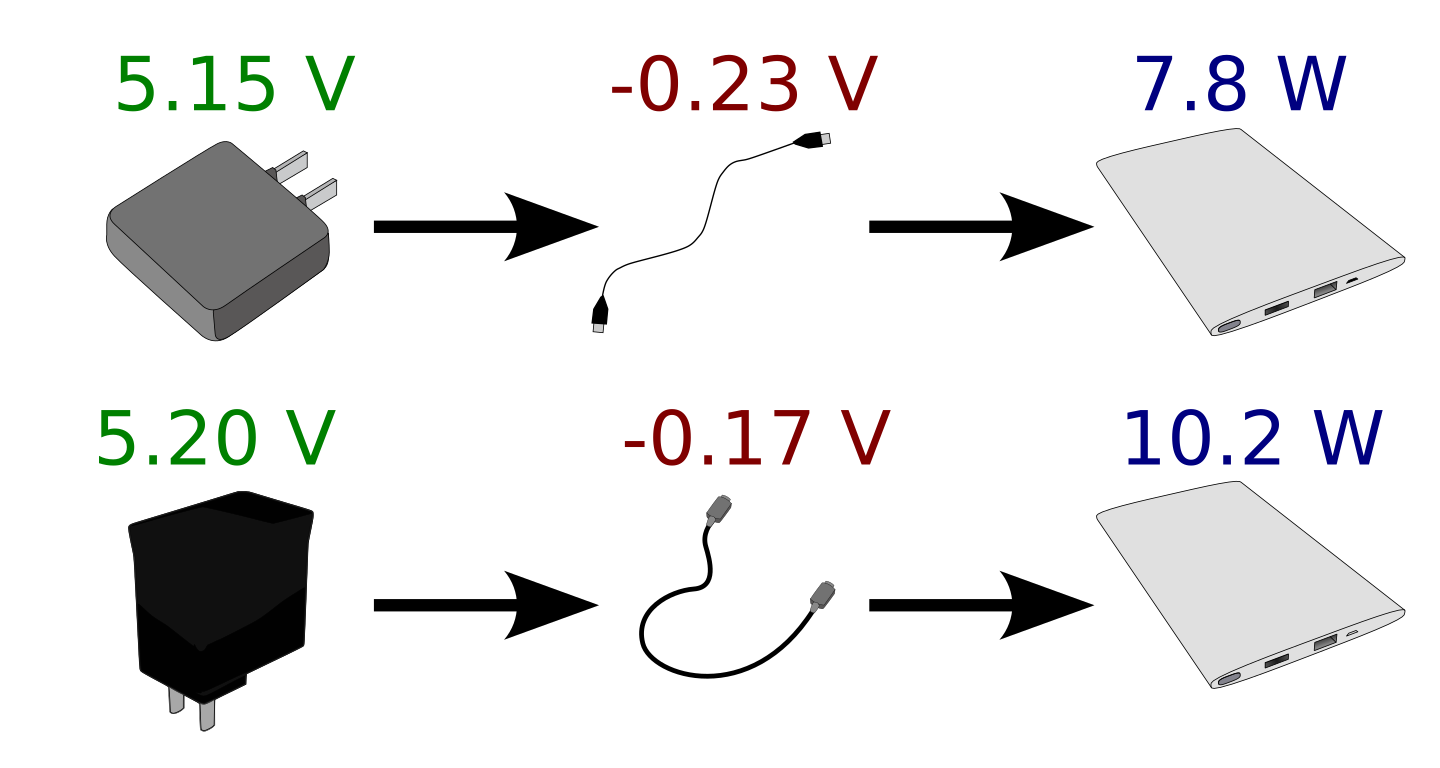
The basics are that if a powerbank is charged with 5.1 V, it will draw around 2.3 A, and if a powerbank is charged with 4.8 V, it will draw around 1.1 A. During charging, the cable decreases the voltage from the charger, and bad ones decrease it more. If the battery is full/almost full, the equation is changed such that the current is reduced in order to prevent battery overvoltage.
Therefore, the charging speed may vary across chargers depending on the output voltage (e.g., a charger that gives 5.23 V instead of 5.15 V may be faster), depending on the charger's voltage stability, and depending on whether there is compensation in the charger). Additionally, across cables depending on: thickness, length, whether there is copper or copper clad aluminium, Type-C/Micro, temperature, etc.
Instead of forcing 2 amps through a poor connection and heating the point of poor connection significantly, the poor connection's voltage drop leads to the I–V curve making charging slow instead.